What is the Preference Center?
A preference center (Preference Center) is an online environment where users can manage their personal preferences regarding communications from an organization. In the Preference Center, users can manage the following settings:
1. Communication Preferences
Whether or not to receive emails
Types or communication: promotions, news, events, product launches, etc.
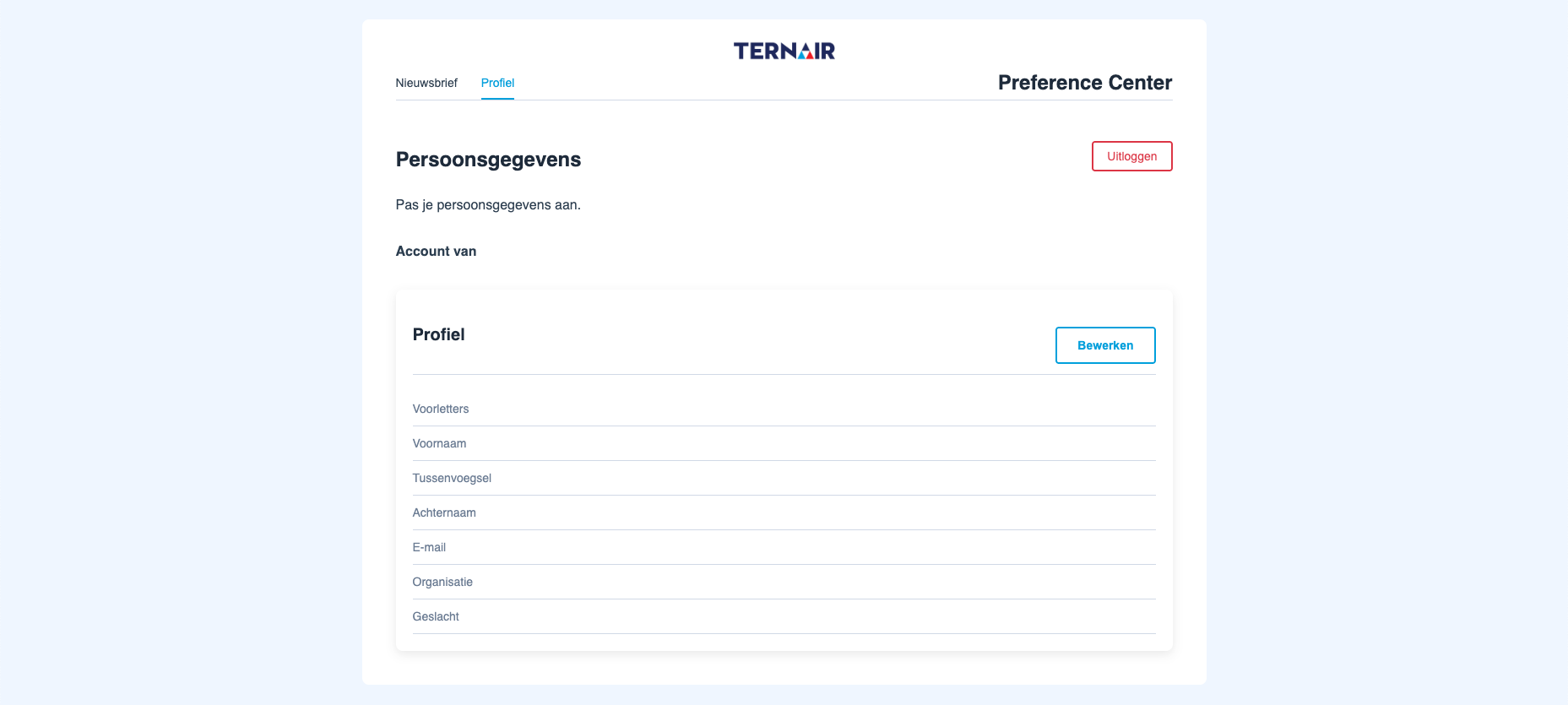
2. Profile Information
Initials
First Name
Insert
Last Name
Email
Organization
Gender
Why is a Preference Center important?
Ease or Use: Customers can decide for themselves what they want to receive.
Relevance: Organizations can better tailor their communications to people's interests.
Privacy and Compliance: It helps ensure compliance with regulations such as the GDPR.
Lower cancellation rate: People are less likely to unsubscribe completely because they are in control.
Preference Center Customization Options
Ternair’s preference center is designed to be flexible and scalable, with extensive configuration options that meet the functional and visual needs or various customers. Its key features are:
Multi-tenant support
The preference center is suitable for multi-tenant environments environments, which means that multiple labels/brands can be managed within a single environment, each with its own configuration. This makes it scalable and efficient to manage.
Secure Profile Management
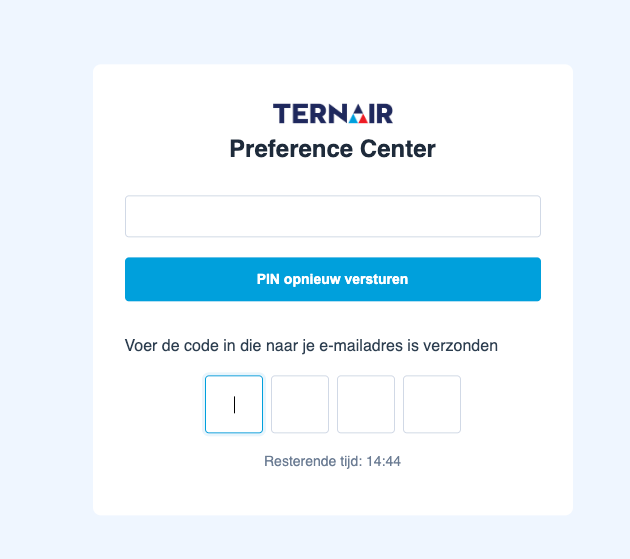
For added security when changing profile information, a PIN via email. This additional verification step prevents unauthorized changes.
Multilingualism and Text Configuration
The preference center supports multiple languages, with text managed through a text-coding system which can be configured via a configuration file. This makes it easy to customize or translate text.
Style can be customized for each customer
Each client environment can be customized to match the client’s own corporate identity. The logo, colors, and font are fully customizable via CSS, based on a default style for each client in accordance with the Ternair style guide. As a result, the preference center aligns seamlessly with each organization’s brand identity.
Email Processing via Webhook
Instead or a traditional SMTP connection, outgoing communication can be handled via a webhook. This simplifies integration and increases flexibility in the email sending process.
Exclusion List Functionality
The system allows you to hide specific lists using an exclusion list. This provides additional control over which communication options are visible to the end user in the preference center.
Interests
Starting in May 2026, it will be possible to express or request interests through the Preference Center. Interests are stored as properties in the Ternair Campaign newsletter management system.
To set up interests for a customer, the following steps are required:
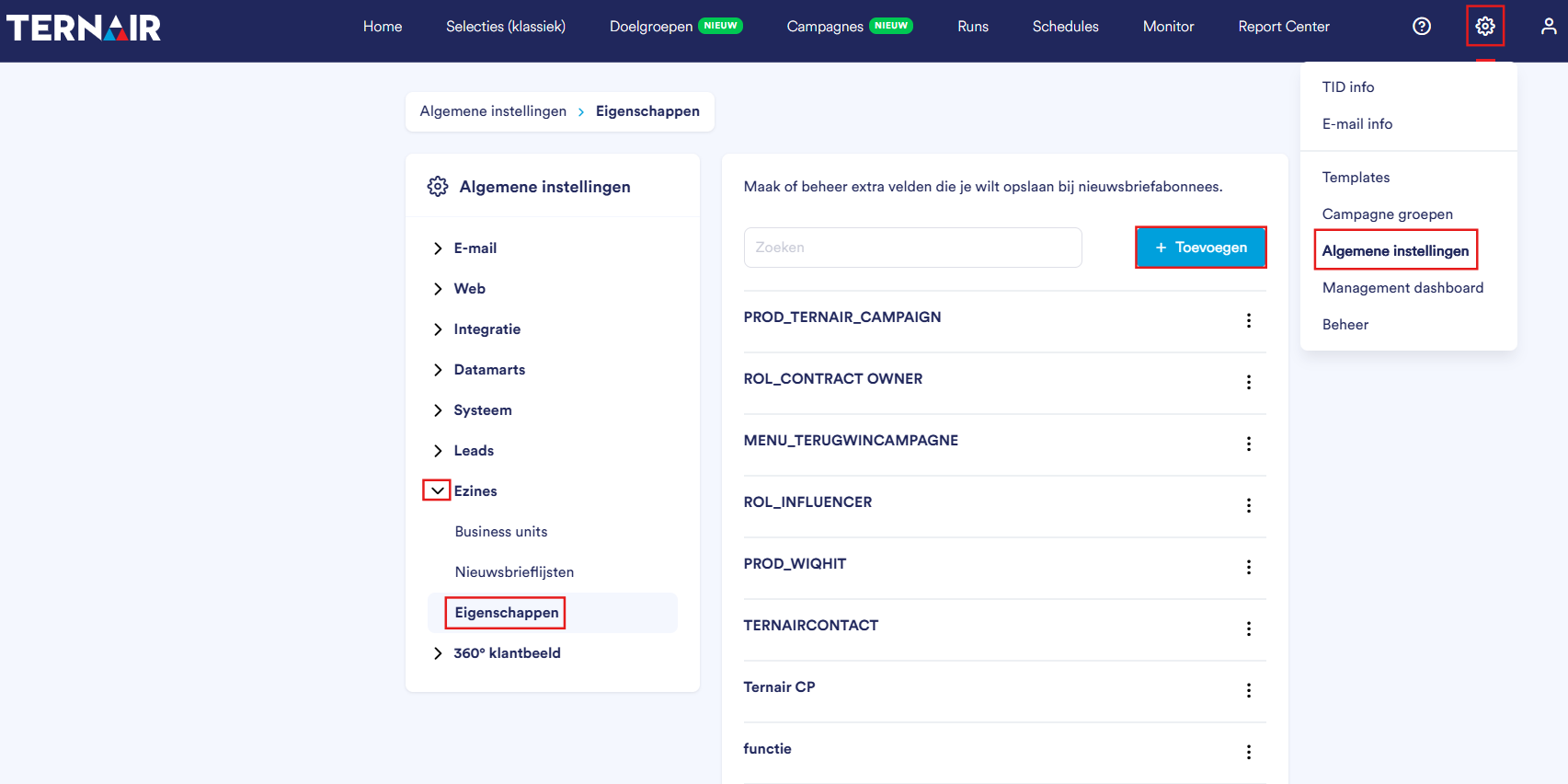
Create the properties in the Ternair Campaign back office, if they do not already exist. The names or the properties are 1:1 saved in the Preference Center. Interests are stored by the Preference Center as a True (1) or False (0). Make sure these properties are set as Can be customized are configured so that they can be updated (see the corresponding screenshots under "Preference Center Structure > Interests Page").
In the Preference Center, create a list or the properties that should be used as interests. As long as this list does not exist, the "Interests" tab will not be displayed in the Preference Center. You can use Ternair’s support application to submit a request to make newsletter properties available as interests in the Preference Center.
Depending on your interests, you can optionally choose a category be specified. You can display all interests without a category, assign them all to one or more categorys, or use a combination or both. For visual examples or these three options, see the Interests page under "Preference Center Structure."
To request changes to existing properties or similar adjustments, you can submit a ticket through Ternair's support application.
Accessibility Preference Center
There are two ways to access the preference center:
Through a login button or personal account on the organization's website*.
Through a link in the message you receive, such as in the footer or an email newsletter. This link is often called “Manage Preferences”, “Update your preferences" or "Adjust Communication Settings”.
By clicking the link, you'll be taken to a secure page where you can easily specify which communications you do or do not wish to receive. For example, via a link such as: preferencecenter.ternair.com
Using TID in the URL
In this case Is a TID (Ternary ID) required? be included in the URL. This unique identifier is used to identify the user securely and accurately.
When the page is opened, the configured API called to determine the corresponding value based on the TID retrieve an email address.
*If there is no TID is present, the user is automatically redirected to the Home Page (the login screen), so that he can still log in securely.
Once the email address has been retrieved, the Interact API called to include all related newsletter subscriptions and profile information retrieve. This data is then displayed in the preference center so that the user can manage or update it.
Preference Center Structure
The Preference Center consists or several functional pages:
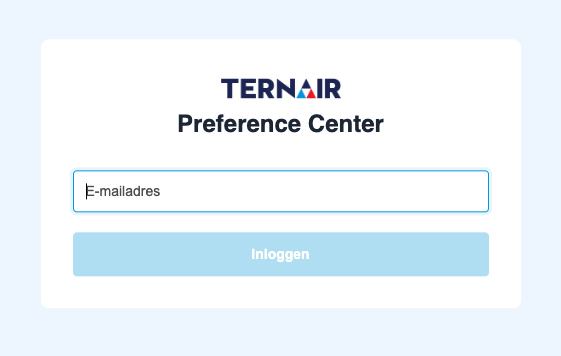
Home Page (Login Screen)
On the home page, or the login screen, the user enters his or her email address. After clicking "Log In," the user receives an email with a PIN to access his or her personal preferences.
Example homepage URL
Newsletter Page
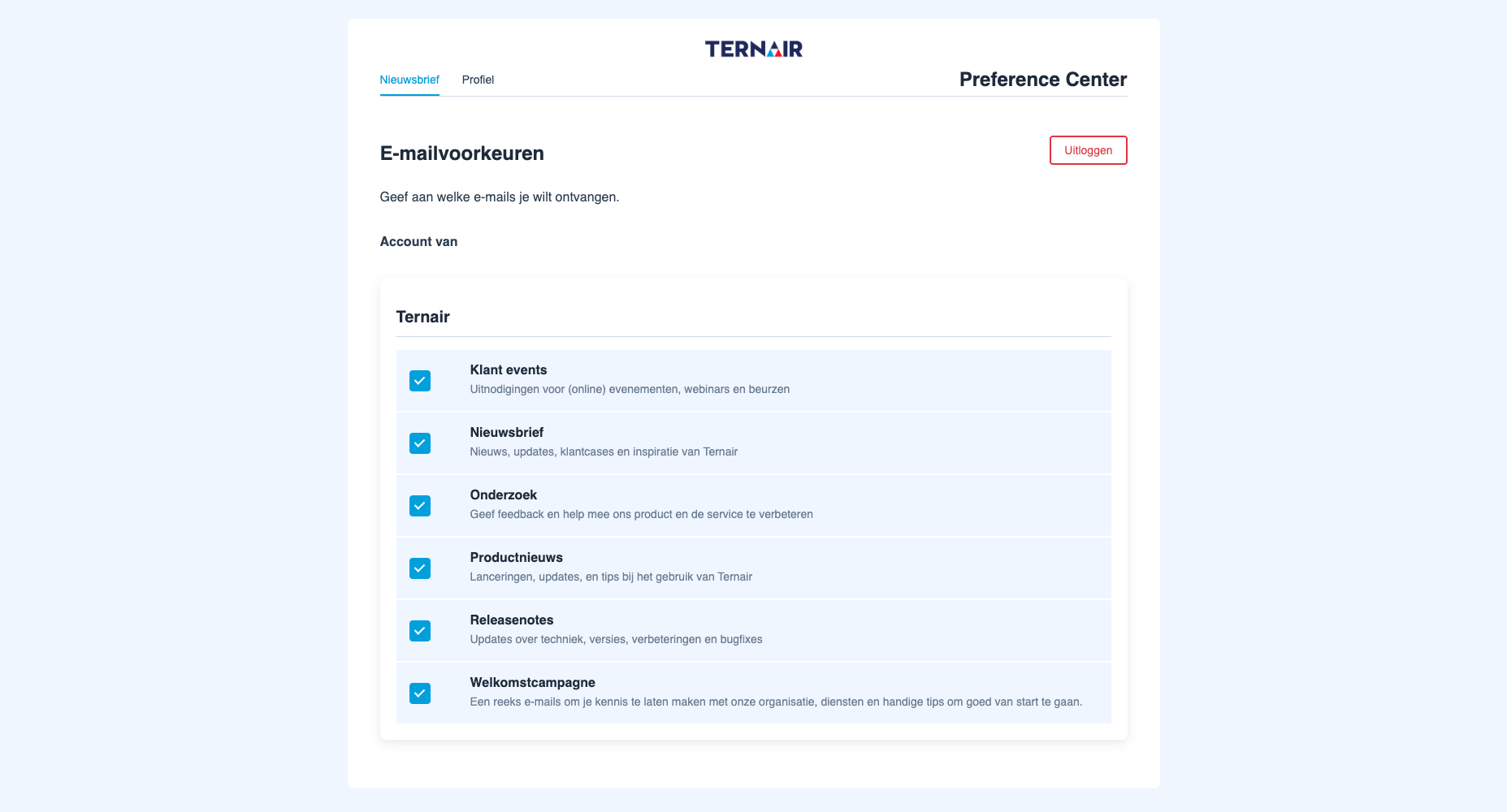
After logging in, the user can go to the Newsletter Page. This section displays the available email lists or newsletter categorys, such as special offers, news, events, and product launches. Users can easily check the boxes to indicate which communications they do or do not want to receive.
The newsletters are retrieved from the list or newsletters defined in the general settings or Ternair Campaign. The newsletter code and descriptions are displayed in the overview. By default, all newsletters are displayed. In the config file, you can specify lists that should not be displayed (e.g., a blacklist).
Sample URL for the newsletter page
{{klanturl}}/profile?tid=~tid~
Unsubscribe Page
Newsletter preferences can be changed directly using checkboxes—without the need for a separate edit mode.
The unsubscribe link contains two essential parameters:
Example URL for the logout page
{{klanturl}}/unsubscribe?ezine_code=[ezinecode]&tid=~tid~
Two Ways to Unsubscribe
You can configure in advance exactly how the cancellation will be processed.
Option 1: The cancellation will be carried out immediately as soon as the page opens.
Option 2: The user first receives a button visible (e.g., “Confirm Unsubscribe”) and must confirm this to actually unsubscribe.
This flexibility makes it possible to tailor sign-off processes to the organization's needs.
Confirmation message after logging out
Once the logout has been successfully processed, a brief confirmation message will appear on the screen:
“You have successfully unsubscribed from this newsletter.”
(This is text code and can be customized for each customer or language.)
Registration Page
The aanmeldpagina is used within the preference center as landing page after a user has double opt-in email has confirmed. This means that someone has explicitly given permission to subscribe to a specific newsletter or campaign (ezine).
Authentication via AAP key
The URL for this page contains a unique AAP key (a GUID), which is used in the API to verify and complete the subscription. This key links the confirmation to the correct contact and the correct newsletter.
Sample URL for the sign-up page
{{klanturl}}/confirm?aapkey=[aapKey]
Confirmation After Registration
Once the registration has been successfully processed, a short confirmation message will appear on the page:
“You have successfully subscribed to this newsletter.”
(This is text code and can be easily customized for each customer or language.)
Profile Page
On the Profile page, users can manage their personal information, such as their name, email address, and gender.
Example profile page URL
{{klanturl}}/profile?tid=~tid~§ion=profile
Read-only and edit mode
By default, the profile is read-only. The data cannot be edited directly. If the user wants to make a change, they must first click the “Edit” button. Only then will the input fields become active, and the profile can be edited.
Subscriptions, on the other hand—such as signing up for or unsubscribing from newsletters—can be changed immediately using checkboxes—without requiring a separate edit mode.
Additional security with a PIN (2FA)
If two-factor authentication (2FA) is enabled, a security code (PIN) will first be sent via email when editing the profile. Only after this PIN is entered correctly will the user gain access to the profile editing function. This prevents unauthorized changes and enhances security.
Changing Your Email Address
Changing the email address requires an additional security step. As soon as a user enters a new email address, a PIN is first sent to the new address. Only after this code is confirmed will the change actually take effect. This prevents the account from being taken over accidentally or maliciously.
Interest Page
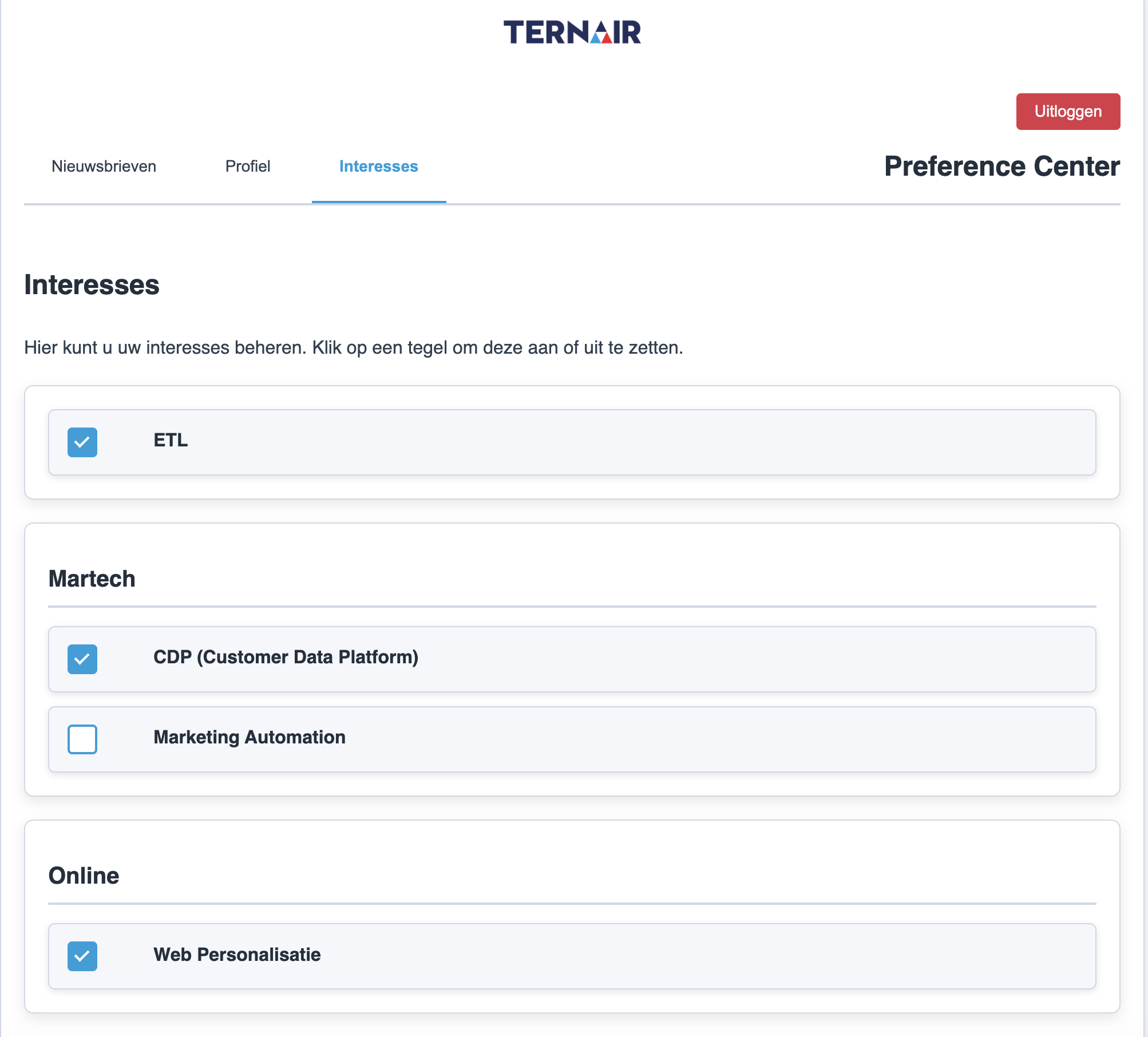
On the Interests page, users can manage their interests. An interest can be either on or off; clicking on it changes its status immediately.
The tab Interests is displayed only if a list or interest properties has been configured in the Preference Center (see Preference Center Customization Options > Interests).
Back-Office Configuration
Interests are created in Ternair Campaign via General Settings > E-zines > Properties. When adding a property, the option Can be customized be checked so that the value can be updated via the Preference Center. To change existing properties or make similar adjustments, use the support application from Ternair, a ticket be submitted.
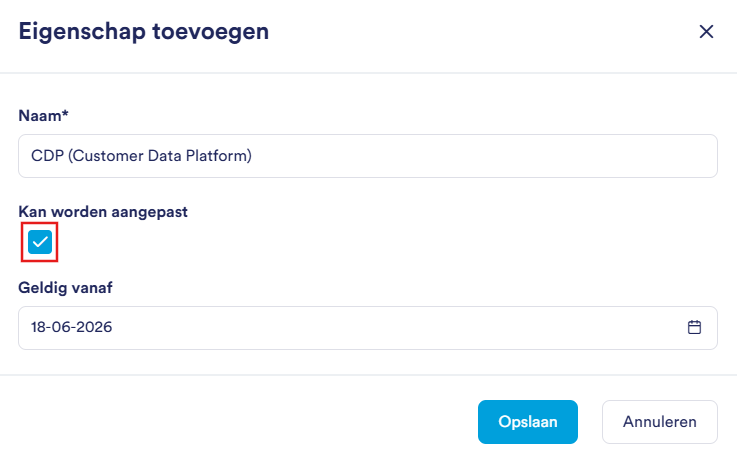
Add a property — make sure the “Can be edited” option is checked.
Display Options
Depending on whether categorys have been defined, the Interests page has three display options:
Option 1 – without categorys: All interests are displayed one below the other as individual tiles.
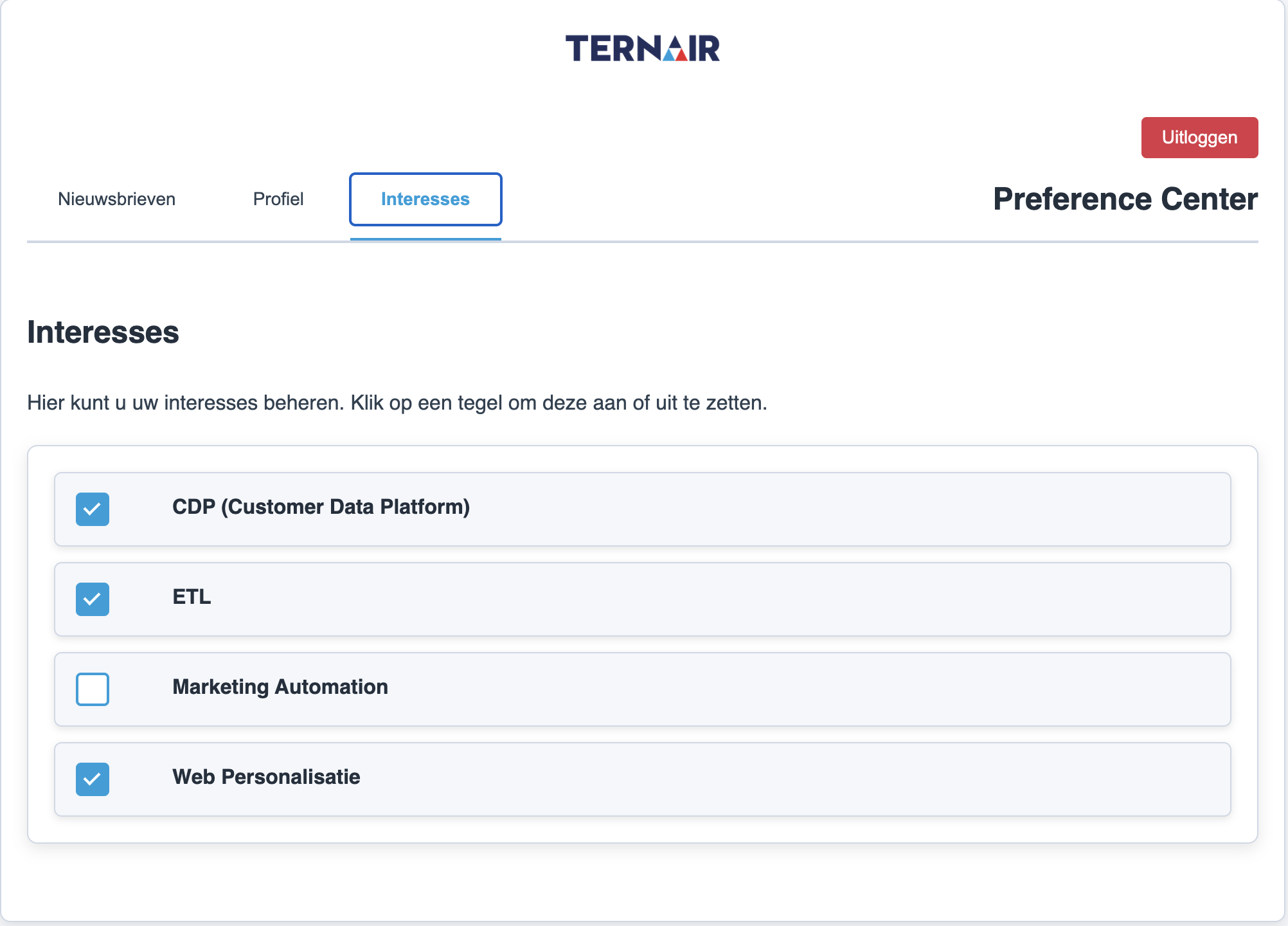
Option 2 – with categorys: The interests are grouped under a category name (for example, Martech and Online).
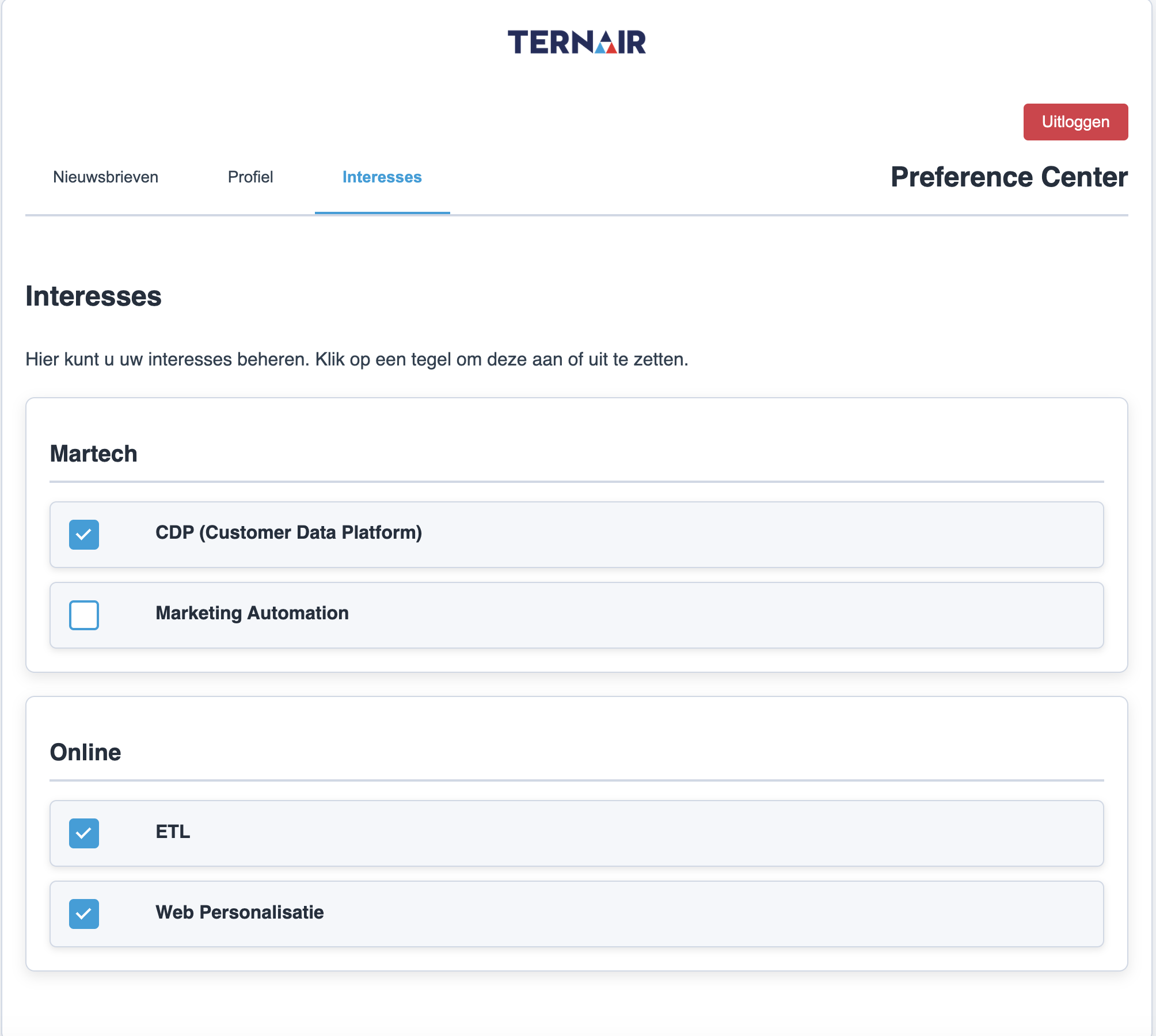
Option 3 – mixed: A combination or interests with and without a category. Interests without a category are displayed at the top or the page (in the example below, that is ETL).